
We Are the Inventor and Manufacturer of Synflex®. Over 1 Million Bottles of Liquid Glucosamine Sold!
Order Synflex® NowView Cart
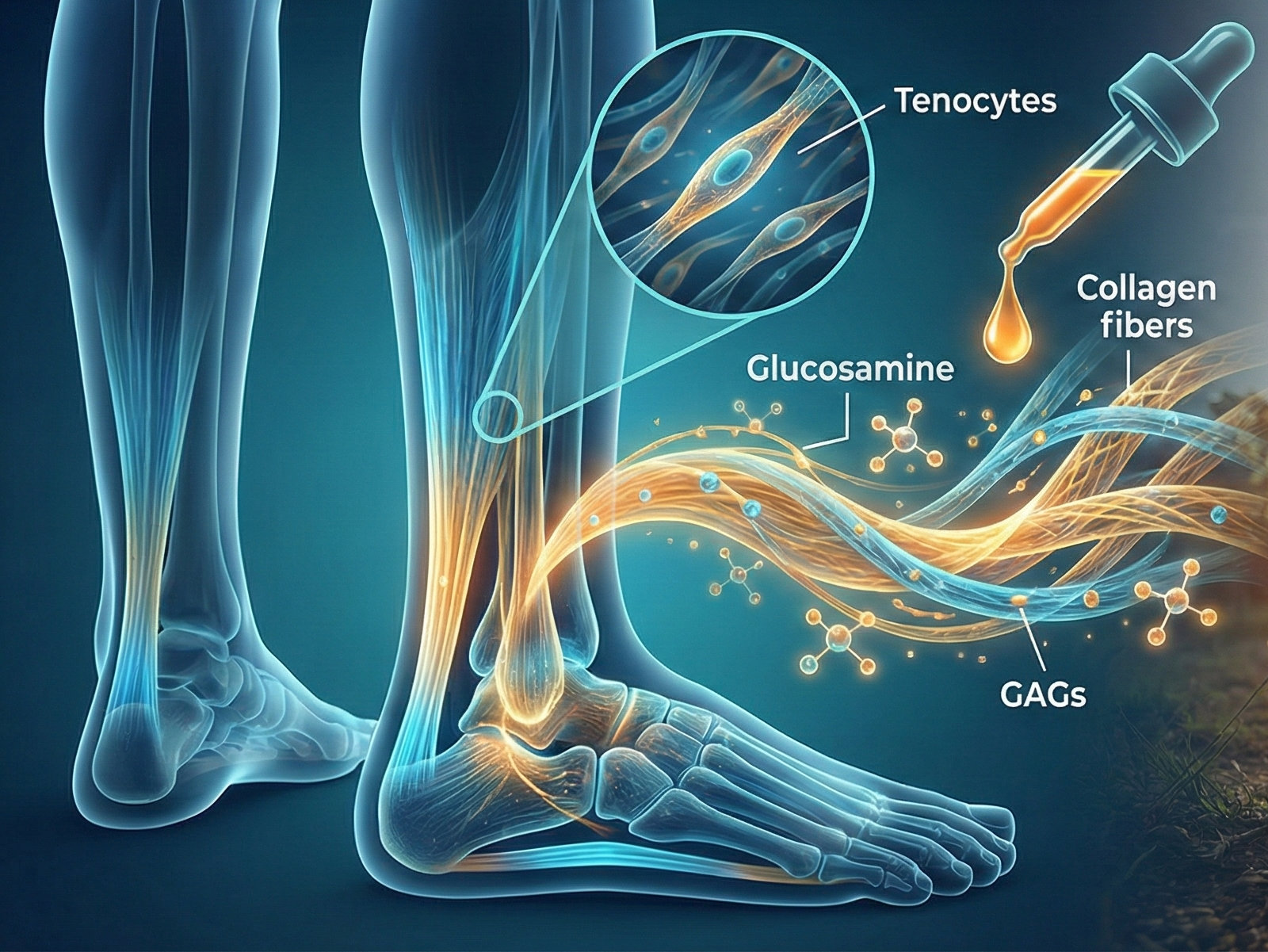
Achilles Tendon Health Read Time: 5 Minutes
The Achilles tendon is an anatomical paradox: it is the strongest tendon in the human body, capable of withstanding forces up to 12 times your body weight, yet it is uniquely vulnerable to degeneration and slow recovery.
While athletes often treat stiffness with standard protocols like rest, ice, and stretching, the biological reality of tendon recovery is far more complex. Emerging cellular research suggests that the key to maintaining this tissue lies not just in mechanical rest, but in providing the specific biochemical precursors required for structural repair.
To understand why liquid glucosamine is becoming a critical tool for soft tissue integrity, we have to look past the surface and into the cellular science of how your body builds the fibers that keep you moving.
To understand how nutrition helps, we must look at the cellular level. Tendons are maintained by specialized cells called tenocytes. These cells are responsible for synthesizing the Extracellular Matrix (ECM)—the structural scaffolding that gives your Achilles its strength.
However, tendons have poor vascularity (blood supply) compared to muscles. When you stress the tendon through overuse, the tenocytes struggle to keep up with the repair process. This creates a “hostile environment” where the breakdown of tissue outpaces the creation of new collagen.
To tip the scales back in favor of recovery, your tenocytes need specific raw materials.
This is where Glucosamine serves as more than just a joint supplement.
The Precursor Role: Glucosamine is a fundamental precursor to glycosaminoglycans (GAGs). GAGs are the essential building blocks of the Extracellular Matrix.
Stimulating Repair: Research indicates that glucosamine can stimulate tenocytes to produce more Type I collagen.
The Result: By increasing the availability of these precursors, you are theoretically enhancing the body’s ability to remodel the tendon structure, helping disorganized tissue regain its strength and alignment.
Recent studies have looked beyond structure to understand how glucosamine interacts with cellular signaling.
The NF-κB Pathway: Research suggests that glucosamine may modulate the NF-κB pathway, a protein complex that controls the body’s response to stress and cytokines.
Enzyme Interaction: Some studies indicate an ability to influence enzymes like COX-2.
Why This Matters: By supporting a healthy response to cellular stress, glucosamine helps maintain an environment where repair can occur naturally, rather than an environment dominated by oxidative stress and breakdown.
The science isn’t just theoretical. Animal studies (specifically in rabbits and rats) have provided compelling data regarding “tendon-to-bone” healing.
In studies where tendons were detached and reattached, subjects treated with glucosamine showed:
Higher Tensile Strength: The healing tendons could withstand more force before failing.
Better Anchorage: The connection point between the tendon and the bone was significantly more secure compared to the control groups.
While human biology is complex, these findings suggest that glucosamine is integral not just for the “rope” (the tendon) but for the “anchor” (where it meets the heel).
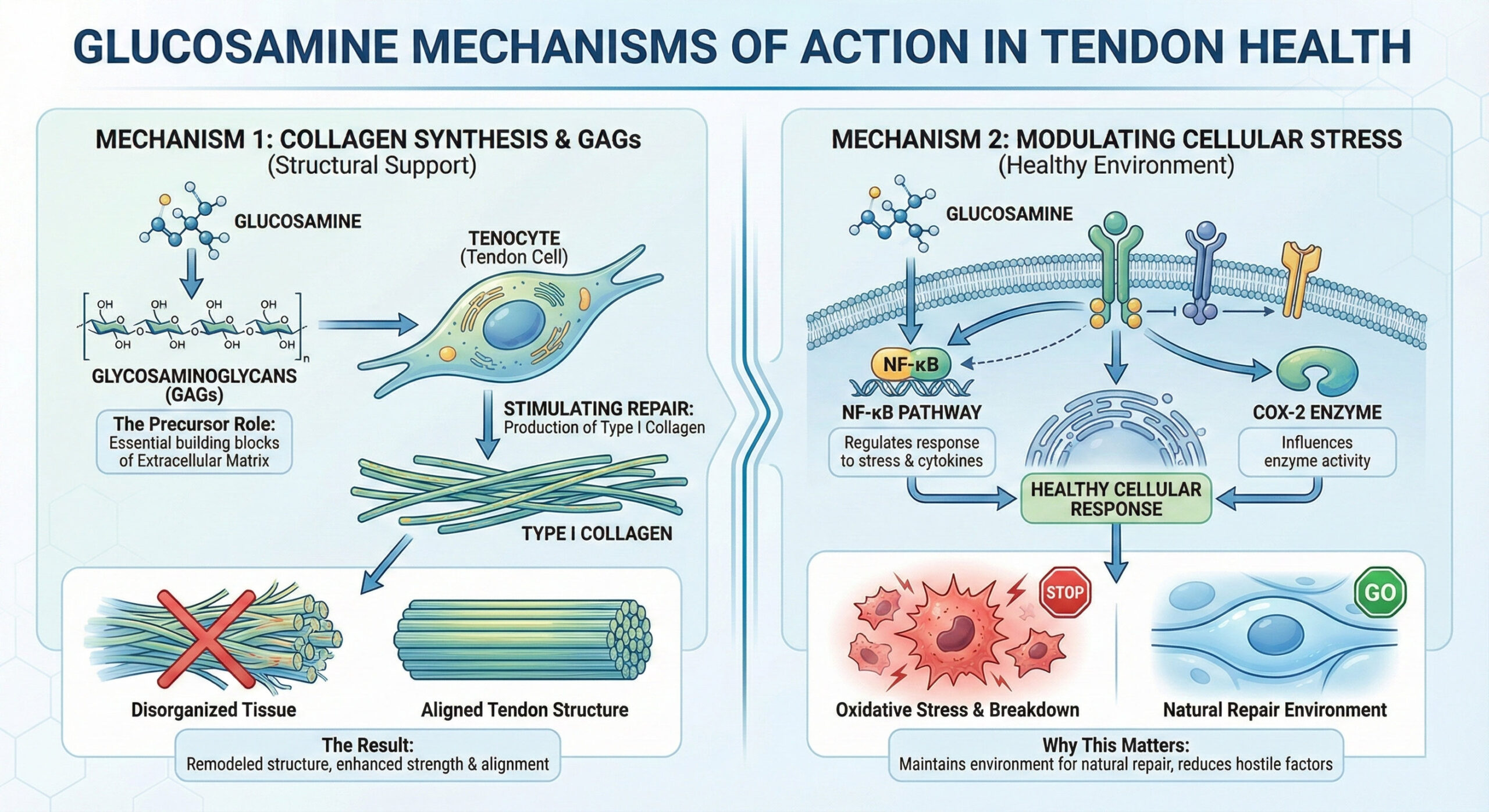
This infographic breaks down the dual mechanisms by which glucosamine supports tendon health: providing the building blocks for repair and helping to modulate cellular stress.
Even the best ingredients fail if they aren’t absorbed. This is where the pharmacokinetics (how the body moves drugs/nutrients) of liquid vs. solid comes into play.
Solubility: Glucosamine pills contain binders and fillers that require significant digestion to break down.
Bioavailability: Synflex® 1500 is formulated as a liquid. This allows for rapid gastric transit and absorption. When you are looking to saturate tissues like the Achilles—which already suffer from low blood flow—high bioavailability is non-negotiable.
We designed Synflex® 1500 to leverage these biological mechanisms. It combines high-impact Glucosamine (1,500 mg) with a synergistic blend of ingredients to support the entire soft tissue complex:
White Willow Bark: Contains salicin, traditionally used to support comfort and mobility.
Boswellin & Bromelain: Enzymatic and botanical support for soft tissue health.
Manganese & Vitamin C: Essential co-factors required for the chemical conversion of glucosamine into collagen.
If you are dealing with a full Achilles rupture (tear), you need immediate medical attention and likely surgery. No supplement can reattach a severed tendon.
However, for the daily wear-and-tear, stiffness, and recovery from athletic exertion, the science is clear: Your tenocytes need support.
By providing a high-absorption source of Glucosamine and supporting nutrients, Synflex® 1500 helps you maintain the structural integrity of the tendons that keep you moving.
[Explore the Science of Synflex® 1500]
Disclaimer: These statements have not been evaluated by the Food and Drug Administration. This product is not intended to diagnose, treat, cure, or prevent any disease.