
We Are the Inventor and Manufacturer of Synflex®. Over 1 Million Bottles of Liquid Glucosamine Sold!
Order Synflex® NowView Cart 
Read Time: 8 Minutes
TL;DR: Glucosamine has picked up attention in longevity circles, and there’s real research behind the interest. Large observational studies have found associations between regular glucosamine use and lower mortality, and animal work has shown lifespan extension in worms and mice. But the human data is observational, effect sizes vary considerably between studies, and at least one large analysis found no association once fully adjusted. It’s a genuinely interesting open question rather than a settled one. Here’s what each study actually found, including the parts usually left out of popular summaries.
Most people encounter glucosamine as a joint supplement. Over the last decade it has also appeared in longevity research, sometimes described as a potential “geroprotector” — a compound that might act on aging processes themselves rather than on a specific disease.
That reputation rests on two very different bodies of evidence, and they’re worth separating, because one is much stronger than the other.
In 2014, a team led by Michael Ristow at ETH Zurich published a study in Nature Communications showing that D-glucosamine extended lifespan in Caenorhabditis elegans and in ageing C57BL/6 mice.
The proposed mechanism is what makes it interesting. Glucosamine appears to mildly inhibit glycolysis — the cell’s sugar-processing pathway — which activates AMP-activated protein kinase and increases mitochondrial biogenesis. The authors describe this as mimicking the molecular effects of a low-carbohydrate diet, and frame it in terms of mitohormesis: a mild metabolic stress that provokes a beneficial adaptive response. In the mice, this came with induction of mitochondrial biogenesis, lowered blood glucose, and increased amino-acid catabolism.
What this doesn’t establish is that any of it happens in humans. Lifespan extension in nematodes and mice is a long way from lifespan extension in people, and the history of geroscience is full of compounds that performed in model organisms and didn’t translate.
One terminology note, since popular coverage frequently gets this wrong: the paper describes mitochondrial biogenesis and mitohormesis, not autophagy. The two are related concepts in aging biology but they aren’t the same thing, and the 2014 study measured the former.
This is where the widely-quoted numbers come from, and where the nuance matters most.
King and Xiang, publishing in the Journal of the American Board of Family Medicine in 2020, analysed 16,686 participants from the National Health and Nutrition Examination Survey and linked them to mortality records. Of those, 658 had been taking glucosamine/chondroitin for a year or longer. Over a median follow-up of about 107 months, they found that after controlling for age, use was associated with 39% lower all-cause mortality and 65% lower cardiovascular mortality.
Those are the figures that circulate online. Here’s what usually gets dropped:
A larger NHANES analysis covering 38,021 adults through 2014 reported that although glucosamine and chondroitin use appeared inversely associated with mortality in minimally adjusted models, no association was observed in multivariable models — hazard ratios of 1.02 for glucosamine and 1.04 for chondroitin, both effectively null.
This result rarely appears alongside the 39% figure, which is unfortunate, because it’s a bigger analysis of the same national dataset finding no effect once confounders were properly accounted for.
The largest dataset on this question comes from UK Biobank: 495,077 participants, roughly 19% of whom reported regular glucosamine use, followed for a median of 8.9 years. In multivariable-adjusted analyses, glucosamine use was associated with a hazard ratio of 0.85 for all-cause mortality and 0.82 for cardiovascular mortality, along with inverse associations for cancer, respiratory and digestive mortality.
That’s about a 15% association for all-cause mortality — statistically robust given the sample size, and considerably more modest than 39%.
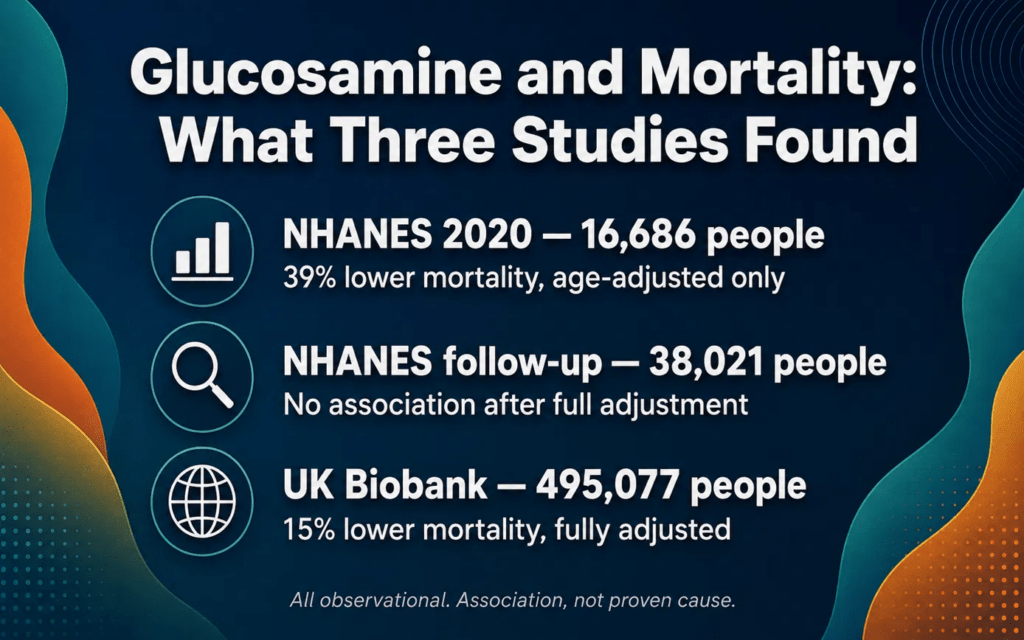
Three observational studies, three different answers. The widely-quoted 39% figure is age-adjusted only; a larger NHANES analysis covering 38,021 adults found no association once fully adjusted, and the UK Biobank cohort of nearly half a million people found roughly 15%.
Multiple large observational datasets have found lower mortality among glucosamine users. The largest and best-adjusted analysis shows a modest effect, one analysis shows none, and the most-quoted figure sits at the optimistic end of the range. No randomised controlled trial has used mortality as an endpoint, and until one does, the healthy-user confound can’t be ruled out.
The association is real and has now appeared across several independent populations, which is why researchers keep looking at it. Whether it reflects causation is a genuinely open question.
One proposed explanation for the mortality associations involves inflammation. Chronic low-grade inflammation is implicated in cardiovascular disease and in aging generally, and there is data suggesting glucosamine and chondroitin use is associated with lower C-reactive protein, a standard inflammatory marker, as well as lower LDL cholesterol.
This is a plausible mechanism rather than a demonstrated causal chain. Lower CRP among supplement users is subject to the same healthy-user caveat as everything else in this area.
Glucosamine also appears in skin-aging research, and this is an area where popular summaries have drifted a long way from what the studies measured.
A 2017 paper in Skin Pharmacology and Physiology examined glucosamine sulphate in skin aging using two approaches. The ex vivo work — on laboratory skin tissue rather than living participants — found significant increases in CD44 expression, collagen type IV, epidermal glycosaminoglycan levels, and collagen type I synthesis.
The clinical portion was small: eight healthy women over 50 took 250 mg of glucosamine sulphate daily for eight weeks, with skin punch biopsies analysed by quantitative PCR for changes in gene expression markers.
What it did not measure was visible wrinkles. Eight participants and molecular endpoints make this a preliminary mechanistic study. The “reduction in visible wrinkles” claim commonly attached to glucosamine online traces back to a different and older study which tested a multi-ingredient formula containing glucosamine alongside amino acids, minerals and antioxidants — meaning the observed effect can’t be attributed to glucosamine specifically.
The underlying biology is reasonable. Glucosamine is a precursor in glycosaminoglycan and hyaluronic acid synthesis, and both matter for skin structure and hydration. But plausible biology and demonstrated cosmetic effect are different claims, and this research is currently at the first stage rather than the second.
A common error in popular writing on this topic runs: a study used 250 mg, product X contains 1,500 mg, therefore product X delivers six times the benefit.
Dose-response relationships have to be measured, not assumed. A study testing 250 mg tells you what 250 mg did in that population, under those conditions, on those endpoints. It says nothing about 1,500 mg. Higher doses can produce proportionally greater effects, plateau, or in some cases do less — which is exactly why researchers run dose-ranging studies instead of extrapolating.
The 1,500 mg figure that appears on most glucosamine products comes from the joint-health literature, where it’s the standard daily dose used in the major trials. That’s a separate body of research from the skin work, and the two shouldn’t be blended together.
If you’re trying to evaluate longevity claims about any compound, a few questions do most of the work:
Glucosamine is one of the more intriguing entries in the geroprotector literature, partly because it’s inexpensive, widely used, and has a long safety record — which makes it an unusually practical candidate if the associations turn out to reflect something real.
What would settle the question is a randomised controlled trial with mortality or a validated aging biomarker as the endpoint. Nobody has run one. Until somebody does, the honest position is that the observational signal is interesting, reasonably consistent across populations, and not yet evidence of cause.
Nobody knows yet. Large observational studies have found associations between regular glucosamine use and lower all-cause and cardiovascular mortality, with the UK Biobank cohort of 495,077 people showing roughly a 15% association. But observational data can’t establish cause, glucosamine users differ systematically from non-users in ways that independently affect mortality, and one large NHANES analysis found no association after full adjustment. No randomised trial has tested this.
A 2020 NHANES analysis published in the Journal of the American Board of Family Medicine. It’s the age-adjusted figure; the same study’s fully adjusted number is closer to 27%. It’s an association from observational data rather than a demonstrated effect, and larger analyses have found smaller or no associations.
The 2014 Nature Communications study describes glucosamine mildly inhibiting glycolysis, activating AMPK, and increasing mitochondrial biogenesis — which the authors characterise as mimicking a low-carbohydrate diet. That’s mitohormesis rather than autophagy specifically, and the work was done in nematodes and mice. Whether it occurs meaningfully in humans is unknown.
There’s no good evidence that it does. A 2017 study measured gene-expression markers in skin biopsies from eight women taking 250 mg daily, and separate laboratory work on skin tissue showed increased collagen synthesis. Neither measured visible wrinkles. Wrinkle-reduction claims generally trace back to a study of a multi-ingredient supplement, so the effect can’t be attributed to glucosamine on its own.
No. Dose-response has to be demonstrated, not extrapolated. Effects can scale, plateau, or reverse at higher doses, which is why dose-ranging studies exist. The 1,500 mg figure common in glucosamine products comes from the joint-health trials, not from the skin research.
A randomised controlled trial with mortality or a validated aging biomarker as the primary endpoint. Randomisation is what removes the healthy-user confound that makes the current observational data so difficult to interpret. No such trial has been conducted.
Written by Louie Barone, Chief Technology Officer at Synflex America. Synflex’s liquid glucosamine formulas have been in continuous use since the late 90s, developed and continuously refined by a chemistry team that specializes in liquid supplement formulation and has studied the synergistic combinations of joint nutrients for more than 25 years. I joined Synflex in 2019 and have spent the years since working directly with customers, reviewing the peer-reviewed literature on glucosamine and joint nutrition, and supporting the team behind the formula.
This article summarises published research for educational purposes and does not constitute medical advice. The studies described report observational associations and preclinical findings; they do not establish that glucosamine prevents disease or extends human life. These statements have not been evaluated by the Food and Drug Administration. Consult your healthcare provider before starting any new supplement, particularly if you are pregnant, nursing, taking prescription medication, or managing a medical condition.