
We Are the Inventor and Manufacturer of Synflex®. Over 1 Million Bottles of Liquid Glucosamine Sold!
Order Synflex® NowView Cart
Achilles Tendon Health Read Time: 5 Minutes
TL;DR: The Achilles is the strongest tendon in the body and one of the slowest to recover, largely because of poor blood supply. Glucosamine is a precursor to the glycosaminoglycans that tendons are built from, and laboratory and animal work has shown effects on collagen synthesis and tendon healing. What doesn’t exist is a randomised trial of glucosamine on its own for tendinopathy — the human research has tested it inside multi-ingredient formulas, several of which produced measurable improvements. Here’s an honest map of what’s established, what’s promising, and what’s still unproven.
The Achilles is an anatomical paradox. It’s the strongest tendon in the human body — during running, loading has been estimated at up to roughly 12 times body weight, with some studies putting peak forces around 9 kN. Yet it’s also notoriously slow to recover once it becomes irritated.
The reason comes down to blood supply. Tendons are poorly vascularised compared with muscle, which means the cells responsible for maintenance and repair receive nutrients and oxygen slowly. Where a strained calf muscle may settle in days, an irritated Achilles can grumble for months.
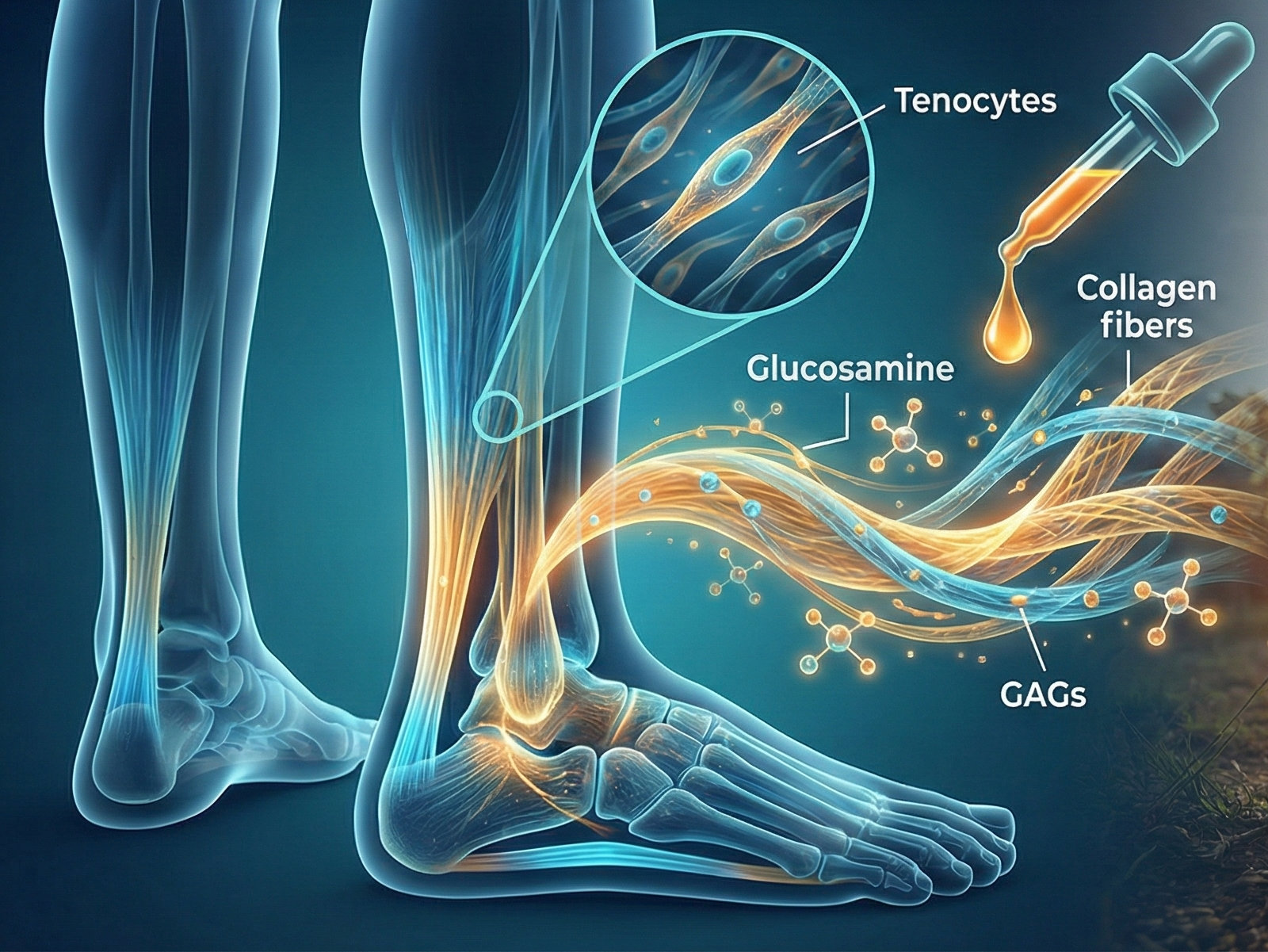
Tendons are maintained by specialised cells called tenocytes. Their job is to synthesise and maintain the extracellular matrix — the structural scaffolding of collagen fibres and glycosaminoglycans that gives the tendon its tensile strength.
Under normal loading, tenocytes keep pace: tissue is broken down and rebuilt in balance. Under repeated overload without adequate recovery, breakdown outpaces synthesis. The collagen architecture becomes disorganised, and what should be neatly aligned parallel fibres becomes a less orderly, mechanically weaker structure. This is the process underlying most chronic tendon pain — which is why the older term “tendonitis” has largely given way to “tendinopathy.” The primary problem usually isn’t inflammation; it’s failed remodelling.
Glucosamine is an amino sugar and a precursor in the synthesis of glycosaminoglycans, which are a structural component of the extracellular matrix in tendon as well as in cartilage. That’s the mechanistic rationale for interest in it here, and it’s a reasonable one.
Laboratory research has gone further. Cell culture and animal studies have reported effects including increased collagen synthesis, improved structural organisation of collagen fascicles, and improvements in tendon tensile strength in animal models. There’s also work suggesting glucosamine may influence the NF-κB signalling pathway, which regulates cellular responses to stress, and enzymes including COX-2.
An important qualification. All of that is preclinical — cells in dishes and animals in laboratories. Preclinical mechanism is how researchers decide what’s worth testing in people. It isn’t evidence that the effect occurs meaningfully in a human tendon at a supplement dose.
Two animal studies come up repeatedly in discussions of glucosamine and tendon healing, and both deserve a fuller account than they usually get.
Taşkesen and colleagues, publishing in 2015, surgically detached and reattached the extensor digitorum longus tendon through a drilled bone tunnel in 28 New Zealand rabbits. Animals receiving glucosamine and chondroitin showed increased cartilage formation at the healing interface at six weeks. The part usually omitted: those differences were no longer observed compared with the control group at twelve weeks. It’s an early-healing effect that didn’t persist, not a durable improvement.
A separate study by Özer and colleagues examined glucosamine-chondroitin in repaired tenotomised rat Achilles tendons, and work by Oryan and colleagues looked at tendon remodelling in rabbits. Both reported favourable findings on collagen organisation and biomechanical properties.
These are genuine results. They’re also surgical repair models in small animals, which is a considerable distance from a runner with a sore Achilles.
This is the part usually skipped, and it’s the most useful section for anyone actually deciding what to do.
There are no randomised controlled trials of glucosamine on its own for tendinopathy. Its substantial human trial evidence is in osteoarthritis. Anyone claiming the science is settled for tendons is overstating it.
What does exist is a body of human research on multi-ingredient supplements that contain glucosamine among several other compounds:
A scoping review of nutritional supplements in tendinopathy management found 16 studies and concluded that several nutritional compounds may be beneficial, while noting a paucity of research overall.
These trials tested formulas, not ingredients. When a supplement containing ten compounds improves outcomes, you cannot say which compound did the work — or whether any single one would do anything alone. That cuts both ways: it isn’t evidence that glucosamine works for tendons, and it isn’t evidence that it doesn’t.
What it does suggest is that the combination approach is where the human signal is. The compounds that keep appearing in these studied formulas — glucosamine, chondroitin, bromelain, Boswellia, vitamin C, collagen — cluster into a recognisable pattern.
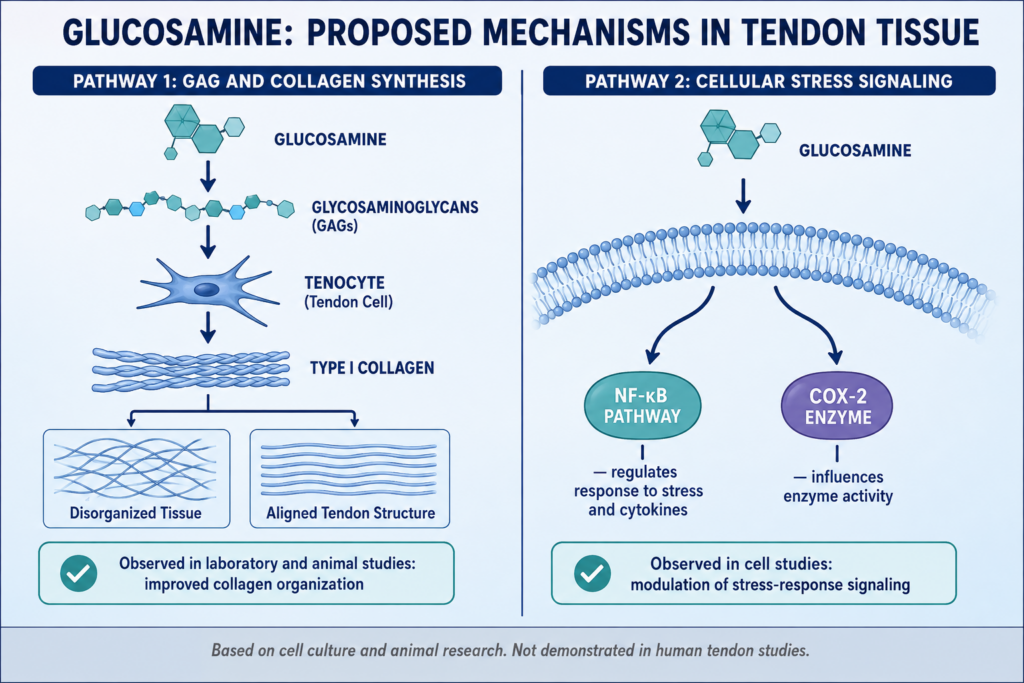
Two proposed pathways by which glucosamine may act on tendon tissue. On the left, glucosamine as a precursor to glycosaminoglycans, which tenocytes use in building the Type I collagen matrix that gives tendon its aligned structure. On the right, modulation of NF-κB and COX-2 signaling, which govern how cells respond to stress. Both pathways come from laboratory and animal research; neither has been demonstrated in human tendon studies.
We’d be doing you a disservice if we let a supplement article imply that supplements are the main event here. They aren’t.
The intervention with the strongest evidence for Achilles tendinopathy is progressive loading. Randomised trials comparing eccentric training with heavy slow resistance training have found both produce substantial improvements in pain and function over 12 weeks. The specific contraction style seems to matter less than reaching an adequate, progressive load that you’ll actually stick with. Notably, in the combination-supplement trial described above, every group improved — including the ones doing physical therapy alone.
Load management, appropriate progression, and patience are the core of it. A supplement is at most an adjunct.
And to be explicit: a full Achilles rupture is a medical emergency. It requires immediate assessment and often surgery. No supplement reattaches a severed tendon, and nothing on this page should delay you getting that looked at.
Synflex 1500 is a liquid formula built around 1,500 mg of glucosamine as glucosamine HCl and glucosamine sulfate, with chondroitin sulfate, white willow bark, flaxseed oil, Boswellia, manganese, yucca, bromelain, and vitamins A and E.
Four of those — glucosamine, chondroitin, bromelain and Boswellia — appear in the multi-ingredient formulas that have been studied in Achilles tendinopathy. That’s an overlap in composition, and we’d rather state it that plainly than dress it up: our specific formula has not been tested in a tendon trial, and composition overlap is not the same as demonstrated efficacy.
One note on a nutrient you’ll see in several of those studied blends: vitamin C, which is a required cofactor for collagen synthesis. Synflex doesn’t contain it. Ascorbic acid degrades in liquid suspension over a product’s shelf life, so rather than list a nutrient that wouldn’t survive to the bottle being opened, we leave it out. If you’re interested in that cofactor, it’s easily covered from diet — citrus, peppers, kiwi, broccoli.
Tendons are built partly from glycosaminoglycans, and glucosamine is a precursor to those. Laboratory and animal research supports a plausible mechanism. Human research on combination formulas containing glucosamine has produced some positive results for Achilles tendinopathy. And no trial has tested glucosamine alone for a tendon condition.
That’s a reasonable case for interest and a poor case for certainty. If you’re managing a cranky Achilles, the loading programme is the treatment and a supplement is an optional addition to it. Talk to a physiotherapist or sports medicine clinician about the former before spending much thought on the latter.
There are no randomised controlled trials of glucosamine on its own for tendinopathy — its human trial evidence is in osteoarthritis. Animal and laboratory studies show effects on collagen synthesis and tendon healing, and human trials of multi-ingredient formulas containing glucosamine have reported improvements in Achilles tendinopathy. But those trials can’t isolate which ingredient was responsible.
Poor blood supply. Tendons are far less vascularised than muscle, so the tenocytes responsible for repair receive nutrients and oxygen slowly. Chronic tendon problems also typically involve failed remodelling and disorganised collagen rather than simple inflammation, which is a slower process to reverse.
A 2015 rabbit study found increased cartilage formation at a surgically repaired tendon-to-bone interface at six weeks, though those differences were no longer present versus control at twelve weeks. Other rat and rabbit studies have reported improved collagen organisation and biomechanical properties. All are surgical repair models in small animals.
Loading is the foundation. Randomised trials show eccentric training and heavy slow resistance training both produce substantial improvements in pain and function over 12 weeks, and any supplement should be built around a loading programme rather than instead of one. That said, supplements aren’t an afterthought either — in one three-arm trial, patients with reactive tendinopathy who added a mucopolysaccharide supplement to their physical therapy had greater reduction in resting pain than those doing eccentric training alone. Glucosamine also has a strong long-term safety record, so for most people it’s a low-risk thing to try alongside the work that’s doing the heavy lifting.
No. A full rupture is a medical emergency requiring immediate assessment and often surgery. No supplement reattaches a severed tendon.
No. Vitamin C is a required cofactor for collagen synthesis and appears in several supplement formulas studied for tendon health, but ascorbic acid degrades in liquid suspension over a product’s shelf life. Rather than list a nutrient that wouldn’t be present when the bottle is opened, it was removed from the formula. Dietary sources cover it easily.
Written by Louie Barone, Chief Technology Officer at Synflex America. Synflex’s liquid glucosamine formulas have been in continuous use since the late 90s, developed and continuously refined by a chemistry team that specializes in liquid supplement formulation and has studied the synergistic combinations of joint nutrients for more than 25 years. I joined Synflex in 2019 and have spent the years since working directly with customers, reviewing the peer-reviewed literature on glucosamine and joint nutrition, and supporting the team behind the formula.
This article summarises published research for educational purposes and does not constitute medical advice. Suspected tendon rupture requires immediate medical attention. These statements have not been evaluated by the Food and Drug Administration. This product is not intended to diagnose, treat, cure, or prevent any disease. Consult your healthcare provider before starting any new supplement, particularly if you are pregnant, nursing, taking prescription medication, or managing a medical condition.