
We Are the Inventor and Manufacturer of Synflex®. Over 1 Million Bottles of Liquid Glucosamine Sold!
Order Synflex® NowView Cart 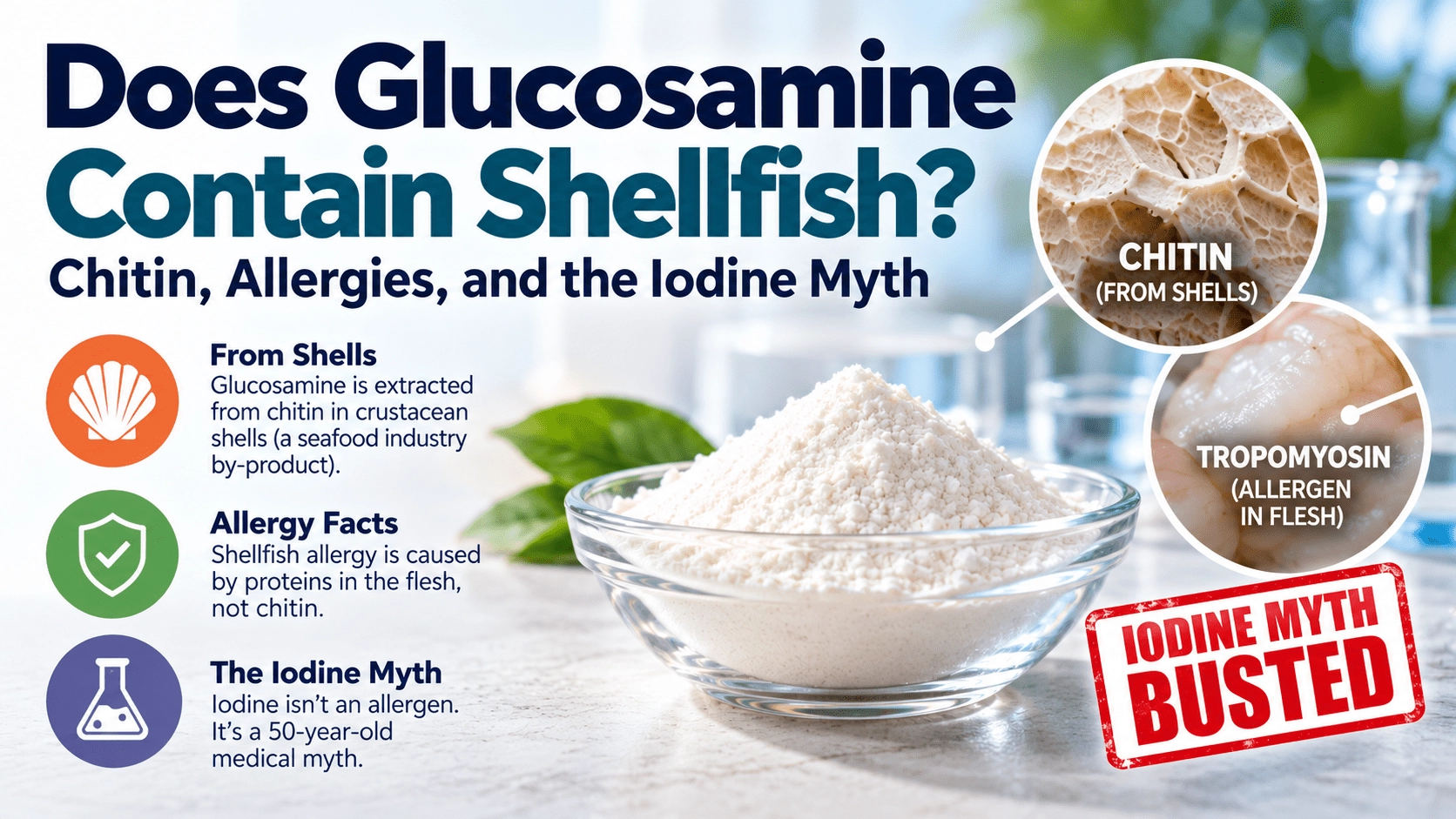
Read Time: 7
TL;DR: Most glucosamine, including Synflex, is made from chitin in crustacean shells. But shellfish allergy is a reaction to tropomyosin, a protein in the flesh, not to chitin, which is a carbohydrate. Purification is designed to strip out proteins, and in a double-blind challenge, shrimp-allergic volunteers tolerated 1,500 mg of shrimp-derived glucosamine without a reaction. The widely held idea that shellfish allergy is really an iodine allergy is a fifty-year-old medical myth. If you have a diagnosed allergy, especially a severe one, your allergist should still have the final word.
Glucosamine is an amino sugar your body makes on its own. The glucosamine in supplements is usually extracted from chitin, the structural material that makes up the hard outer shells of shrimp, crab, and lobster. Chitin is a long chain of glucosamine-based units, so breaking it down and purifying the result yields glucosamine.
That makes crustacean shells, a by-product of the seafood industry, the most common commercial source. Synflex uses shellfish-derived glucosamine, as does most of the glucosamine on the market.
It isn’t the only source. Glucosamine can also be produced by fermentation using corn or fungal starting material, which is how “vegan” and “shellfish-free” glucosamine is made. We’ll come back to that.
This is the distinction that clears up most of the confusion.
Shellfish allergy is an immune reaction to specific proteins. The dominant one is tropomyosin, a muscle protein found in the meat of shrimp, crab, lobster, and other shellfish. It’s recognised by the majority of shellfish-allergic people, and it’s the reason a bite of shrimp can trigger a reaction within minutes.
Chitin isn’t a protein at all. It’s a polysaccharide, the same broad family as starch and cellulose, and it has no structural relationship to tropomyosin. The allergen lives in the part of the animal people eat. Glucosamine comes from the part they throw away.
Chitin isn’t unique to shellfish. It’s also the main structural material in the cell walls of fungi, including the mushrooms on your dinner plate, and in insect exoskeletons.
If chitin itself were the trigger for shellfish allergy, you’d expect shellfish-allergic people to react to mushrooms too. Shellfish allergy doesn’t carry over to mushrooms. That’s a simple, everyday hint that chitin isn’t the problem.
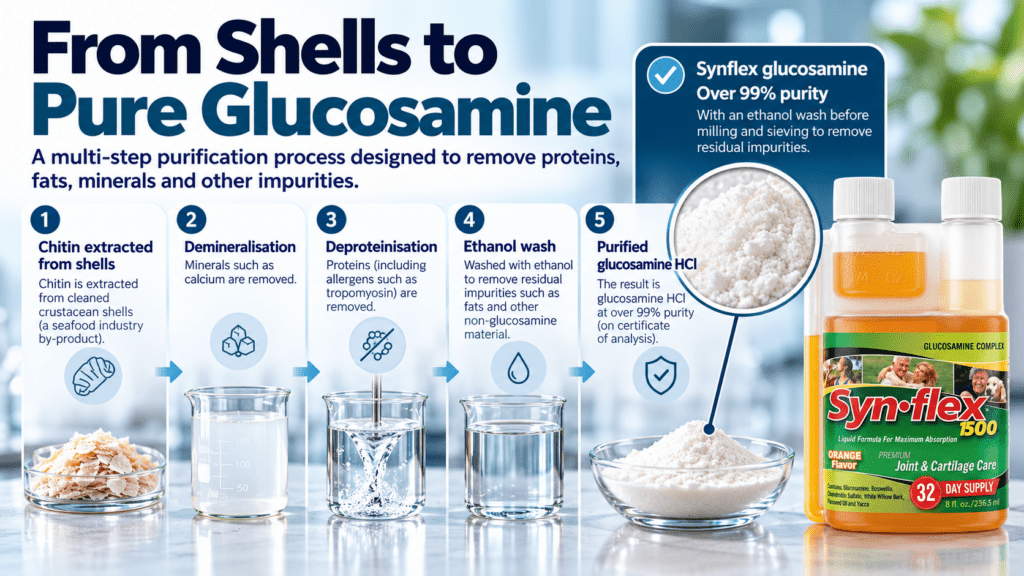
In the living animal, chitin isn’t pure. It’s bound up with proteins, minerals, and fats, which means raw shell material can carry traces of tropomyosin. The manufacturing process is designed to remove them: shells are demineralised and deproteinised to isolate the chitin, which is then broken down and purified into glucosamine.
Riccardo Muzzarelli, a chemist who spent decades studying chitin, argued in a 2010 review in Marine Drugs that purified crab, shrimp, prawn, and lobster chitins should not be considered as “crustacean derivatives” at all. His reasoning: the isolation process removes proteins, fats, and other contaminants so thoroughly that the result is a refined chemical, no more connected to the animal than refined starch is to the potato it came from.
There’s an honest qualification here, and it matters. A UK government advisory committee reviewing chitin-based materials noted that tropomyosin is unusually heat-stable and can persist when deproteination is incomplete, with some researchers recommending clear labelling on chitin-derived products for that reason. In other words, the chemistry says the allergen shouldn’t be there, but how well a given manufacturer does the purification is what determines whether it actually isn’t.
We asked. Our glucosamine manufacturer confirmed that the glucosamine HCl we use tests at over 99% purity on its certificate of analysis, and that before milling and sieving, the material is washed with ethanol to remove residual impurities. That puts a firm ceiling on everything that isn’t glucosamine: under 1% of the material, total.
The most direct evidence comes from a 2006 study in Clinical & Experimental Allergy by Villacis and colleagues.
Researchers recruited people with a history of shrimp allergy and confirmed it two ways: a skin-prick test and a blood test for shrimp-specific antibodies. Fifteen people with confirmed sensitivity then took part in a double-blind, placebo-controlled food challenge, the gold standard for allergy testing, receiving 1,500 mg of either shrimp-derived or synthetically produced glucosamine without knowing which.
Every participant tolerated both, with no immediate allergic reactions and none reported in the following 24 hours. The authors concluded that glucosamine from the manufacturers tested did not contain clinically relevant levels of shrimp allergen.
Two fair notes on that result. Fifteen people is a small study, and the conclusion is explicitly about the specific products tested, which brings us back to purification quality. It’s strong, reassuring evidence. It isn’t a guarantee for every product or every person.
Many people with shellfish allergies have been told they’re “allergic to iodine.” It’s one of the most persistent misconceptions in medicine, and it’s worth taking apart because it causes real problems.
Iodine is an element, and an essential one. Your thyroid needs it to make hormones, it’s present in every human body, and it’s added to most table salt. The immune system doesn’t form allergic antibodies to a simple element your own body depends on. A 2025 joint consensus statement from the American College of Radiology and the American Academy of Allergy, Asthma & Immunology states plainly that iodine is not an allergen.
The idea is often traced to a 1975 paper in the American Journal of Roentgenology by William Shehadi, which reported that about 15% of patients who reacted to iodine-based contrast dye also reported a seafood allergy. The link stuck, and iodine got the blame.
What later research showed is that people with allergies of any kind, and people with asthma, react to contrast dye somewhat more often than the general population. Seafood allergy carries no more risk than other food allergies. The common thread is an allergy-prone immune system, not iodine.
The myth has survived for half a century, including among physicians. In a 2008 survey of 231 faculty radiologists and interventional cardiologists, Beaty and colleagues found that 69% asked patients about seafood allergy before contrast procedures, and 37% said they would withhold contrast or premedicate on that basis.
That has consequences. An “iodine allergy” flag in a medical record can lead to a needed scan being delayed or to unnecessary steroids and antihistamines. If you’ve been told you have one because of a shellfish allergy, it’s worth raising with your doctor.
Some people need to watch the amount of iodine they take in, rather than avoid it as an allergen. That’s common with certain thyroid conditions, and it’s a perfectly reasonable thing to ask about any supplement.
Chitin and glucosamine contain no iodine in their molecular structure. Glucosamine is built from carbon, hydrogen, nitrogen, and oxygen. Any iodine in the original shell material would be a contaminant rather than part of the molecule, and the purification steps described above are designed to remove contaminants.
When we put the question to our manufacturer, they confirmed there is no iodine content in the glucosamine, based on the over-99% purity on the certificate of analysis and the ethanol wash. To be precise about that answer: it’s drawn from purity and process rather than from a specific iodine test. It isn’t a measured figure, but it does mean that less than 1% of the material is anything other than glucosamine, and iodine would be only a fraction of that.
Not everyone asking “does this contain shellfish?” is asking about allergies.
Kosher diets. Shellfish aren’t kosher, and kosher certification agencies generally won’t certify shellfish-derived glucosamine. People keeping kosher typically choose a certified fermentation-derived product. Questions about how purification interacts with Jewish dietary law are best taken to a rabbi.
Vegan and vegetarian diets. Shellfish-derived glucosamine isn’t vegan. Fermentation-derived glucosamine is.
Worth knowing for anyone weighing their options: the large clinical trials on glucosamine, including the three-year Reginster study in The Lancet and the GAIT trial, were run on shellfish-derived material. That’s the reason Synflex uses it: it’s the form the research was built on.
Synflex’s glucosamine is derived from shellfish: it’s extracted from chitin in crustacean shells, then purified. Our manufacturer reports the glucosamine HCl at over 99% purity on its certificate of analysis, with an ethanol wash before milling to remove residual impurities. Shellfish allergy is caused by proteins in the flesh, which the purification process is designed to remove.
The evidence is reassuring. In a 2006 double-blind, placebo-controlled challenge, 15 people with confirmed shrimp allergy took 1,500 mg of shrimp-derived glucosamine with no allergic reactions. Shellfish allergy is caused by tropomyosin in the flesh, while glucosamine comes from chitin in the shell. That said, the study was small and specific to the products tested, so check with your allergist first, especially if you’ve had severe reactions.
No. Chitin is a polysaccharide, chemically unrelated to tropomyosin, the protein responsible for most shellfish allergy. Chitin is also found in mushroom cell walls, and shellfish allergy doesn’t carry over to mushrooms. Raw chitin can carry traces of shellfish protein, which is why purification quality matters.
No. Iodine is an essential element that every human body contains, and it isn’t an allergen. A 2025 consensus statement from the American College of Radiology and the American Academy of Allergy, Asthma & Immunology says so directly. The myth is often traced to a 1975 study on contrast dye reactions.
Glucosamine’s molecular structure contains no iodine; it’s made of carbon, hydrogen, nitrogen, and oxygen. Synflex’s manufacturer confirmed there is no iodine content in its glucosamine, based on over-99% purity and an ethanol wash. That conclusion comes from purity and process rather than a specific iodine assay.
Yes. Fermentation-derived glucosamine, made from corn or fungal sources, contains no shellfish material and is an option for people keeping kosher or following a vegan diet. Most of the major clinical research on glucosamine used shellfish-derived material.

Written by Louie Barone, Chief Technology Officer at Synflex America. Synflex’s liquid glucosamine formulas have been in continuous use since the late 90s, developed and continuously refined by a chemistry team that specializes in liquid supplement formulation and has studied the synergistic combinations of joint nutrients for more than 25 years. I joined Synflex in 2019 and have spent the years since working directly with customers, reviewing the peer-reviewed literature on glucosamine and joint nutrition, and supporting the team behind the formula.
This article is intended for educational purposes and does not constitute medical advice. If you have a diagnosed shellfish allergy, consult your allergist or physician before starting any supplement derived from shellfish. These statements have not been evaluated by the Food and Drug Administration. This product is not intended to diagnose, treat, cure, or prevent any disease.