
We Are the Inventor and Manufacturer of Synflex®. Over 1 Million Bottles of Liquid Glucosamine Sold!
Order Synflex® NowView Cart 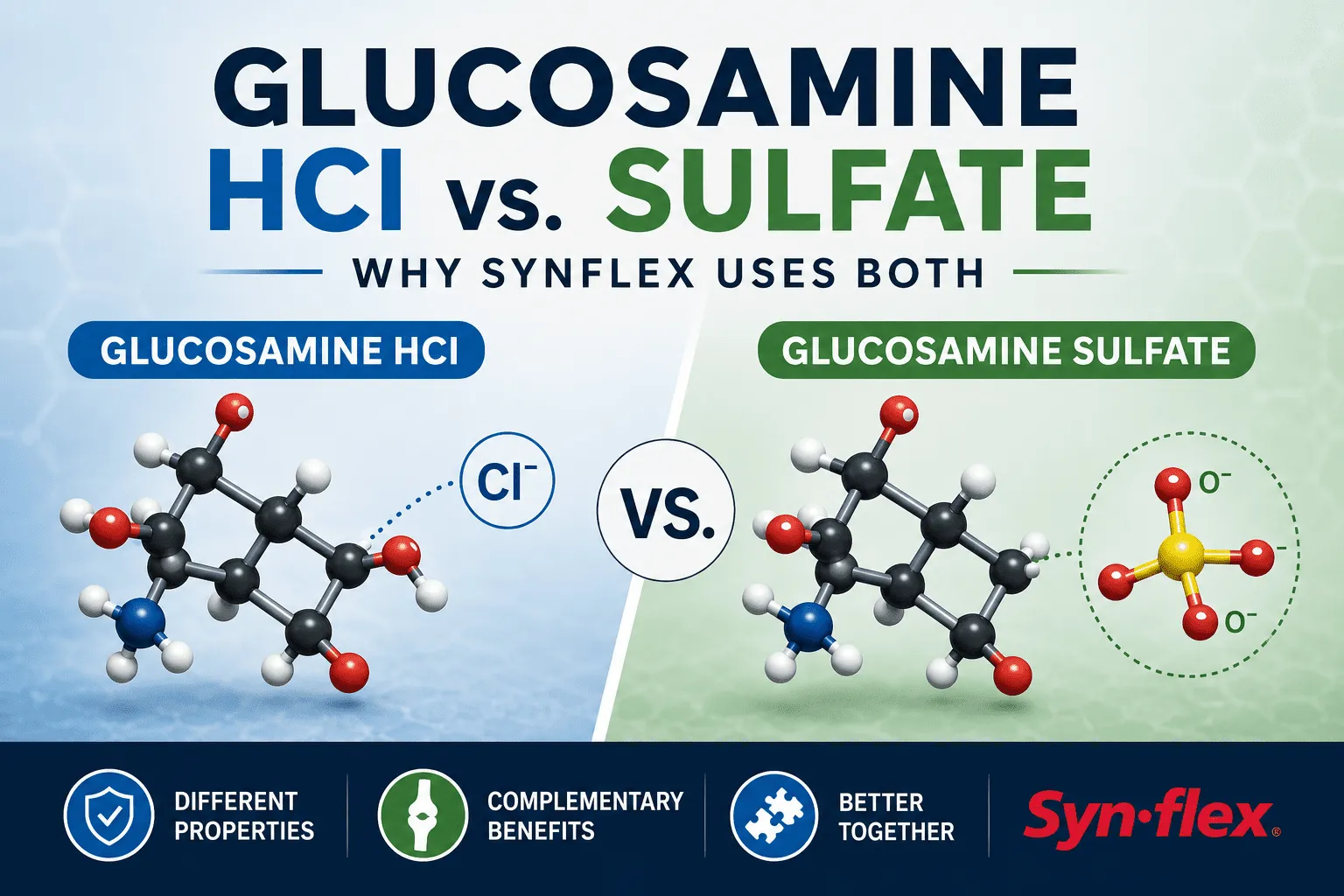
Read Time: 7 Minutes
The two most common forms of glucosamine — hydrochloride (HCl) and sulfate — aren’t rivals so much as two tools that do slightly different jobs. Glucosamine HCl is more concentrated and more stable, delivering more actual glucosamine per milligram. Glucosamine sulfate is a little less concentrated, but the sulfate it carries is itself a raw material your cartilage uses. Most products pick one and defend it. Synflex uses both, because the research supporting each form is strong enough that choosing sides means leaving something on the table. Here’s the full breakdown.
Both start from the same place: glucosamine, an amino sugar your body naturally produces and uses to build and maintain cartilage. The difference is what the glucosamine is paired with to make a stable, usable powder.
Glucosamine is unstable on its own, so it’s manufactured as a salt — bonded to another compound that keeps it shelf-stable. The two standard choices are:
That single chemical difference drives everything else — concentration, stability, and the secondary role each form can play in the body.
Glucosamine HCl, and it’s not close.
Because the hydrochloride group is lighter than the sulfate group (and because sulfate forms are typically bulked out with a stabilizing salt), HCl delivers substantially more glucosamine per gram. Roughly speaking, glucosamine HCl is around 83% glucosamine by weight, while stabilized glucosamine sulfate is closer to 60%. In practice, that means a smaller amount of HCl can deliver the same active dose — an advantage that matters enormously in a liquid, where every ingredient competes for space in the bottle.
This is one reason HCl is the workhorse of the Synflex formula: it lets us pack a genuinely high glucosamine dose into a small, concentrated liquid serving without the added sodium load that sulfate’s stabilizers bring.
This is where the picture gets more interesting — and where the honest answer is “it depends on which study you read.”
Some pharmacokinetic research suggests glucosamine sulfate is modestly better absorbed. A frequently cited animal study in horses found median oral bioavailability of roughly 9.4% for glucosamine sulfate versus 6.1% for glucosamine hydrochloride, along with higher glucosamine levels in joint fluid at 1 and 6 hours after a sulfate dose. (It’s worth noting this was an equine model — useful as a controlled comparison of the two salts, but not a direct measurement of what happens in people.)
Other research finds no meaningful difference. Since both salts dissociate — break apart into their component ions — in stomach acid almost immediately, several researchers argue that once they hit your gut, “glucosamine is glucosamine,” and any difference comes down to the specific formulation rather than the salt itself.
The fair summary: the evidence modestly favors sulfate on absorption, but it’s genuinely mixed, and the gap is smaller than most marketing claims suggest. This is exactly the kind of unsettled question where hedging your bet by including both forms is more defensible than betting the whole formula on one.
Because sulfate isn’t just a delivery vehicle — it may be doing useful work of its own.
Cartilage is built largely from glycosaminoglycans and proteoglycans, and those molecules are sulfated. Building and maintaining them requires a steady supply of sulfur. Some researchers have proposed that part of glucosamine sulfate’s value is precisely this: it supplies sulfate that chondrocytes (your cartilage cells) can draw on to sulfate the very structures they’re building. There’s even a hypothesis that this helps offset low sulfur availability in older adults who eat less protein.
Is this fully proven? No — it remains a proposed mechanism rather than settled fact. But it’s a plausible, biologically grounded reason that the sulfate form might contribute something the hydrochloride form can’t, independent of the glucosamine itself. And it’s why simply saying “HCl has more glucosamine, so HCl wins” misses part of the story.
Put the pieces together and the logic for a dual-form approach falls out naturally:
A product that uses only HCl gets great concentration but forgoes the sulfate contribution and the form with the strongest long-term structural data. A product that uses only sulfate gets that sulfate benefit but sacrifices concentration and adds sodium — a real drawback in a liquid where space is at a premium.
Using both means the formula doesn’t have to make that trade-off. You get the concentration and stability of HCl and the sulfate contribution that pairs so naturally with the chondroitin sulfate and manganese sulfate already in the Synflex formula. It’s the same design philosophy that runs through everything we make: the “syn” in Synflex stands for synergy, and that applies to the forms of glucosamine themselves, not just the supporting ingredients. (For more on how those ingredients work together — and the best way to take your daily dose — see our guide on when to take liquid glucosamine.)
One practical reason the dual-form approach matters more in a liquid than in a pill: sodium and stability.
Commercial glucosamine sulfate is usually stabilized with sodium chloride or potassium chloride. In a tablet, that’s a minor consideration. In a concentrated daily liquid, leaning entirely on sulfate would meaningfully raise the sodium content of each serving — not ideal for anyone watching their intake. Glucosamine HCl needs no such stabilizer, so blending the two lets us capture sulfate’s benefits while keeping sodium in check.
HCl’s superior moisture resistance and shelf stability also help the finished liquid hold up over the life of the bottle — the same stability concern that led us to source vitamin C from your diet rather than include degradable ascorbic acid in the formula.
If you’ve ever stared at two glucosamine products — one advertising “pure HCl,” the other “clinically studied sulfate” — and wondered which camp is right, the honest answer is that both camps have a real point. HCl genuinely is more concentrated and stable. Sulfate genuinely does carry a cartilage-relevant raw material and has the bulk of the long-term structural research behind it.
The forms aren’t competitors. They’re complementary. And after more than 25 years of formulating liquid joint supplements, that’s the conclusion our chemistry team keeps arriving at: when the evidence for two good options is this closely matched, the sophisticated move isn’t to pick a side — it’s to use both, and let them do what each does best.
Neither is universally “better” — they have different strengths. HCl is more concentrated and stable; sulfate is slightly better absorbed in some studies and supplies sulfur that cartilage uses. This is why Synflex includes both rather than choosing one.
Studies using glucosamine HCl have generally shown results comparable to sulfate, though some pharmacokinetic research (including animal studies) gives sulfate a modest edge on absorption. The evidence is mixed enough that neither form has decisively “won.”
Much of the influential long-term research — including multi-year trials on osteoarthritis progression — happened to use glucosamine sulfate. That’s partly a matter of which form researchers chose to study, not necessarily proof that sulfate is superior in every respect.
Commercial glucosamine sulfate is typically stabilized with sodium or potassium chloride, so it carries more sodium than glucosamine HCl. This is one reason Synflex balances the two forms rather than relying on sulfate alone, especially since it’s a concentrated liquid.
Possibly, yes. Cartilage structures are sulfated, and building them requires sulfur. Some researchers propose that glucosamine sulfate’s sulfate group supplies raw material for this process, though this remains a proposed mechanism rather than fully settled science.
Both. Synflex uses a combination of glucosamine HCl and glucosamine sulfate, alongside chondroitin sulfate, manganese sulfate, and other supporting ingredients, to capture the strengths of each form in one liquid dose.
Written by Louie Barone, Chief Technology Officer at Synflex America. Synflex’s liquid glucosamine formulas have been in continuous use since the late 90s, developed and continuously refined by a chemistry team that specializes in liquid supplement formulation and has studied the synergistic combinations of joint nutrients for more than 25 years. I joined Synflex in 2019 and have spent the years since working directly with customers, reviewing the peer-reviewed literature on glucosamine and joint nutrition, and supporting the team behind the formula.
This article is intended for educational purposes and does not constitute medical advice. These statements have not been evaluated by the Food and Drug Administration. This product is not intended to diagnose, treat, cure, or prevent any disease. Consult your healthcare provider before starting any new supplement, particularly if you are pregnant, nursing, taking prescription medication, or managing a medical condition.