
We Are the Inventor and Manufacturer of Synflex®. Over 1 Million Bottles of Liquid Glucosamine Sold!
Order Synflex® NowView Cart 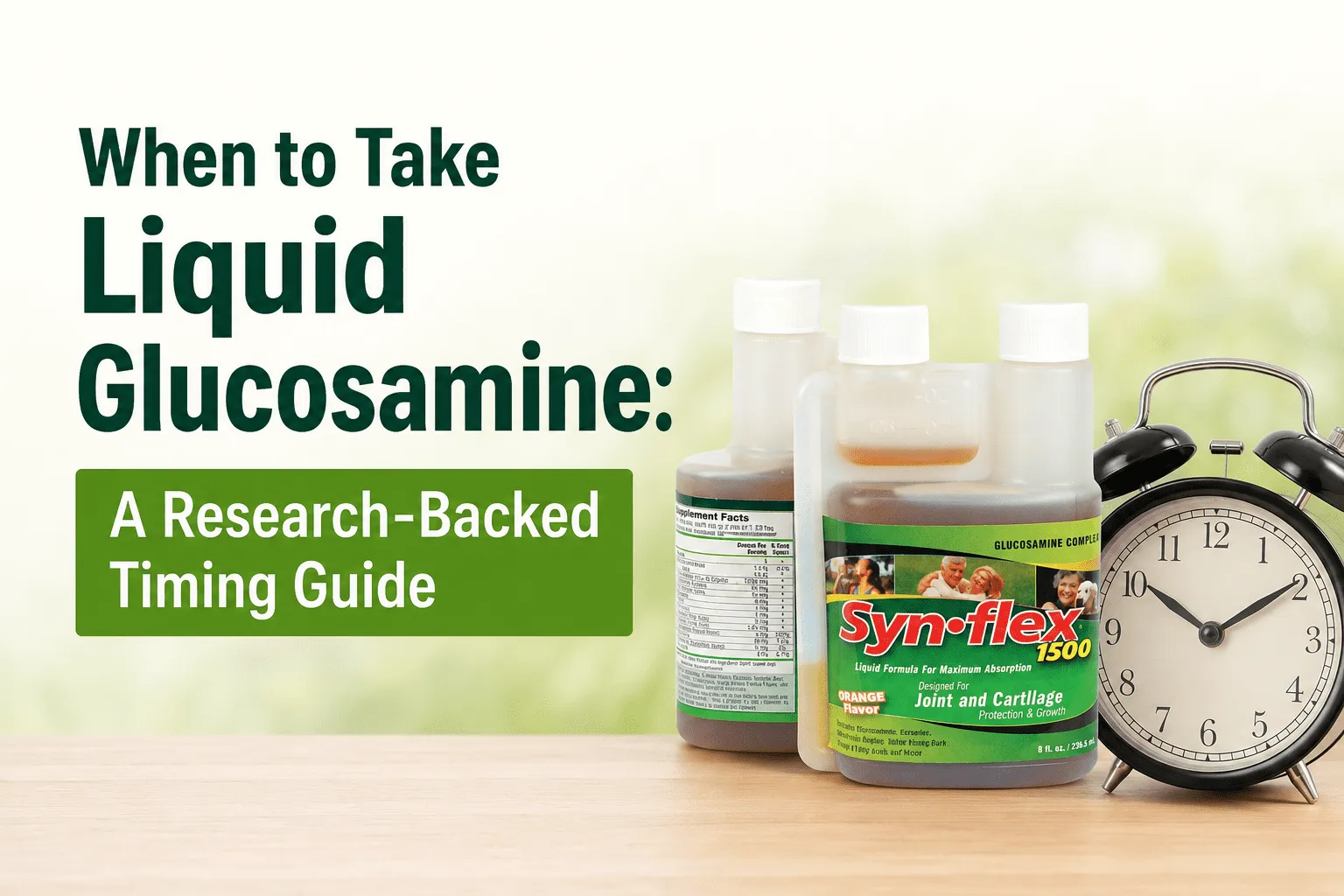
Read Time: 8 Minutes
TL;DR: For glucosamine and chondroitin, when you take it matters far less than whether you take it consistently. There’s no proven circadian advantage to morning or night. Taking it with food can help if you’re prone to stomach upset, but it isn’t required. The real leverage comes from pairing glucosamine with synergistic nutrients — vitamin C, omega-3s, manganese, anti-inflammatory botanicals — most of which are already built into the Synflex Original and Synflex 1500 formulas. And because liquid glucosamine bypasses the 20–30 minute breakdown that pills require, the timing-with-food question that haunts tablet users is largely moot for liquid.
Short answer: no.
Glucosamine is a small, water-soluble molecule (it’s essentially an amino sugar). It absorbs in the small intestine through the same transport pathways your body uses for other simple sugars and amino acids. There is no established circadian rhythm in glucosamine bioavailability — meaning your gut doesn’t absorb it noticeably better at 8 AM than it does at 8 PM.
What the research has established is that if glucosamine and chondroitin help, the benefit builds gradually — trials measure outcomes over months, not hours. It’s worth being upfront that the evidence is genuinely mixed. The largest U.S. trial, the Glucosamine/chondroitin Arthritis Intervention Trial (Clegg et al., NEJM, 2006), found that glucosamine and chondroitin were not significantly better than placebo for the average patient with knee osteoarthritis. Other long-term research, such as Reginster’s three-year trial in The Lancet (2001), reported measurable benefits to joint structure. Where a benefit does occur, reviewers generally note it takes 4 to 12 weeks of daily, consistent use to appear.
In other words: this isn’t a supplement that works in hours. Whatever benefit you get accrues gradually, which is why the dose you skipped last Tuesday matters more than the exact time you take today’s. Consistency beats timing — every time.
Either is fine. Here’s the nuance.
The case for with food: A small minority of users experience mild gastrointestinal discomfort — usually nausea or bloating — when taking glucosamine on an empty stomach. Food buffers this almost completely. If you have a sensitive stomach, take it with breakfast or dinner.
The case for empty stomach: Animal pharmacokinetic studies have shown that in fasted conditions, plasma glucosamine area-under-the-curve can be approximately 1.7-fold higher than in fed conditions when dosed at certain times of day. This means a fasted dose may produce a higher peak concentration. Whether that peak translates into better clinical outcomes is unproven — the studies showing benefit have used both fed and fasted dosing.
Our practical recommendation: Take it however you’ll remember to take it. If you currently take it with your morning coffee or before bed and that’s working, don’t change anything. The “perfect” dose you skip is worse than the “imperfect” dose you take every day.
There is no clinical evidence favoring either. Choose based on lifestyle:
That depends on which dose you’re taking — and the answer is built into the Synflex bottle itself.
Synflex’s dosing reservoir has two fill lines: 1/4 oz (the standard maintenance dose, delivering 1,500 mg of glucosamine in Synflex 1500) and 1/2 oz (an intensive dose, delivering 3,000 mg). The reservoir wasn’t designed for fractionating below 1/4 oz, and there’s no practical reason to.

If you’re on the standard 1/4 oz daily dose: Take it once a day, whenever fits your routine. There is no meaningful clinical benefit to splitting a single 1,500 mg serving into two 750 mg halves, and the bottle isn’t built to make that easy.
If you’re on the 1/2 oz daily protocol (often used by customers managing significant inflammation, advanced cartilage loss, or recovery from injury): this is where splitting makes sense. Glucosamine has a relatively short plasma half-life — a single 3,000 mg dose produces one tall peak followed by a long valley. Taking two 1/4 oz pours, one in the morning and one in the evening, produces two smaller peaks and a more sustained presence in the bloodstream. The dosing reservoir is designed to support either approach: pour the full 1/2 oz at once, or use two separate 1/4 oz pours throughout the day.
For historical context: the landmark GAIT trial (Clegg et al., 2006) dosed participants with 500 mg of glucosamine three times daily, not 1,500 mg all at once — a signal that researchers favored spreading the daily dose for steadier exposure when working at the higher end of the dosing range.
This is where things get interesting — and where the synergy part of joint nutrition shows up.
Glucosamine alone is a building block. Several other nutrients amplify what it can do, either by supporting cartilage synthesis directly, by reducing the inflammatory environment that breaks cartilage down, or by acting as cofactors in the biochemical reactions glucosamine participates in.
| Nutrient / Food | Why it pairs with glucosamine | Where to get it |
|---|---|---|
| Omega-3 fatty acids (EPA/DHA, ALA) | A 2009 study by Gruenwald et al. (Advances in Therapy) found glucosamine + omega-3s matched glucosamine alone at the primary endpoint (≥20% pain reduction), but produced more “strong responders” (≥80% pain reduction) in a secondary analysis | Fatty fish, fish oil, flaxseed oil, walnuts, chia |
| Vitamin C | Required cofactor for collagen synthesis; cartilage is largely collagen | Citrus, bell peppers, strawberries, kiwi, broccoli |
| Manganese | Cofactor for the enzymes that build glycosaminoglycans — the structural molecules of cartilage | Whole grains, leafy greens, nuts, legumes |
| Vitamin D | Lower vitamin D status is associated with worse osteoarthritis outcomes in observational studies | Sunlight, fatty fish, fortified dairy, supplements |
| Bromelain | Proteolytic enzyme with anti-inflammatory activity studied alongside joint supplements | Fresh pineapple (core has the most) |
| Boswellia (frankincense extract) | Inhibits 5-lipoxygenase, an inflammatory pathway involved in joint discomfort | Boswellia serrata extract supplements |
| Curcumin (turmeric) | Multiple meta-analyses support modest anti-inflammatory and joint-comfort effects | Turmeric with black pepper (boosts absorption ~20x) |
| Vitamin E | Fat-soluble antioxidant; reduces oxidative stress in joint tissues | Almonds, sunflower seeds, avocado, olive oil |
| Adequate water | Synovial fluid — your joints’ lubricant — is mostly water | Hydration throughout the day |
This is where the name comes from. The “syn” in Synflex stands for synergy — and the formulas were designed in the late 90s specifically around the recognition that glucosamine works better in combination than alone.
Synflex is available in two formulations. Synflex 1500 is our flagship, with the full 1,500 mg of glucosamine and white willow bark added for additional anti-inflammatory support. Synflex Original Formula uses 1,250 mg of glucosamine and omits white willow bark — a good choice for customers who prefer a simpler formulation or are sensitive to salicin.
Here’s what’s in a single 1/4 oz serving of Synflex 1500:
| Ingredient | Amount | Role |
|---|---|---|
| Glucosamine HCl + Glucosamine Sulfate | 1,500 mg | Cartilage building block |
| Chondroitin Sulfate | 25 mg | Cartilage building block; works with glucosamine |
| White Willow Bark | 10 mg | Natural source of salicin (anti-inflammatory) |
| Flaxseed Oil | 10 mg | Plant-source omega-3 (ALA) |
| Boswellia (Boswellin) | 8 mg | 5-LOX inhibitor; anti-inflammatory |
| Manganese (Sulfate) | 5 mg | Cofactor for cartilage synthesis |
| Yucca | 3 mg | Saponins with anti-inflammatory activity |
| Vitamin E | 1.5 mg | Antioxidant |
| Bromelain | 1 mg | Proteolytic enzyme, anti-inflammatory |
| Vitamin A (Palmitate) | 24 mcg RAE | Supports tissue maintenance |
Curious why we use both forms of glucosamine rather than one? We break it down in glucosamine HCl vs. sulfate.
Synflex Original Formula uses the same supporting ingredient profile with 1,250 mg of glucosamine and without the white willow bark.
A note on vitamin C: it was originally in the formula but was removed because ascorbic acid degrades in liquid suspension over the shelf life of the product, and we’d rather not include a nutrient that wouldn’t be there by the time you opened the bottle. The easy fix is dietary — pair your Synflex dose with an orange, a kiwi, or a glass of orange juice and you’ll have the vitamin C cofactor in your bloodstream at the same time.
You may notice Synflex doesn’t include MSM (methylsulfonylmethane), a sulfur donor found in some competing formulas. Our formulation team chose a different approach: chondroitin sulfate and manganese sulfate supply the sulfur the body uses for connective tissue, while a multi-botanical stack — Boswellia, white willow bark (in Synflex 1500), bromelain, and yucca — addresses inflammation through several independent pathways (5-lipoxygenase, cyclooxygenase, proteolytic, and saponin-mediated). Both approaches have merit; this is the one we’ve refined since the late 90s.
Here’s where most timing advice — written for pills — falls apart.
A glucosamine tablet has to do several things before any of the active ingredient reaches your bloodstream: disintegrate in stomach acid, dissolve the powder, release the active compound from binders and fillers, and only then begin absorption in the small intestine. This process typically takes 20–30 minutes for a tablet to even begin releasing nutrients. Food in the stomach affects how quickly that disintegration happens — which is why pill-based timing advice is genuinely complicated.
Liquid glucosamine starts at step five. It’s already dissolved. Absorption can begin in seconds rather than half an hour, which is one of the main reasons consumers and clinicians often choose liquid formulations.
So the practical implication for liquid users is this: the bulk of “with food vs. empty stomach” and “morning vs. evening” advice was developed around solid-dose pharmacokinetics that don’t fully apply to a pre-dissolved liquid. The window between dose and absorption is so much shorter that the variables matter less.
The bottom line, after more than 25 years of formulating liquid joint supplements and answering this question from customers:
Take your Synflex at the same time every day, with or without food. Pair it with a generally anti-inflammatory diet — fish, berries, nuts, extra virgin olive oil. Stay hydrated. And give it 6 to 12 weeks before you judge whether it’s working.
The supplement only works if you remember to take it. Everything else is optimization at the margins.
Yes, with one important caveat: don’t mix Synflex into hot coffee. Heat can degrade glucosamine and the other actives in the formula. Taking your Synflex dose alongside your hot coffee — a sip of one, then the other — is completely fine, since there’s no documented interaction between caffeine and glucosamine absorption. If you’d rather mix it into a beverage, iced coffee, cold juice, water, or a cool smoothie all work well. The general rule: keep liquid glucosamine away from heat.
Yes. Liquid glucosamine mixes well into juice, smoothies, or water. Mixing with orange juice has the added benefit of pairing with vitamin C, a cofactor for collagen synthesis.
Food slightly slows the rate of absorption for almost everything you ingest, but it doesn’t reduce the total amount absorbed for glucosamine in any clinically meaningful way. Take it with food if your stomach prefers it.
Most clinical studies measure outcomes at 12 to 24 weeks. Customers commonly report changes in 4 to 8 weeks, but a fair trial is at least 8 weeks of consistent daily use before you decide.
Generally yes — including with multivitamins, omega-3s, vitamin D, and turmeric. If you’re taking calcium supplements at very high doses, consider separating them by an hour or so to avoid any mineral absorption competition.
The best time is whatever time you will actually remember to take it. If you’re choosing between optimization options: with breakfast (paired with vitamin C from fruit) or split between breakfast and dinner are both reasonable choices.
Some customers — particularly those managing significant inflammation, advanced cartilage loss, or recovery from injury — take a higher daily amount, often a “loading dose” of two servings per day (1/2 oz total, delivering 3,000 mg of glucosamine in Synflex 1500). After several weeks, many of these customers step back down to the standard serving once they feel their joints are in a better place. Glucosamine has a wide safety margin in the published literature, but if you’re considering a higher daily amount — especially if you take anticoagulants like warfarin, manage diabetes, or have other health conditions — talk it over with your healthcare provider first.
No. Store Synflex in a cool, dark place. Refrigeration isn’t necessary and can thicken the liquid more than is ideal for pouring and dosing.
Yes. Glucosamine and chondroitin have been studied in trials lasting up to three years (Reginster et al., Lancet, 2001) with no signal of accumulating safety concerns in the general population. Talk to your physician if you take anticoagulants like warfarin, are pregnant or nursing, or have a shellfish allergy and want clarity on the source.
For absorption speed, yes — liquids bypass the disintegration step that tablets require. For total absorption, the evidence is more mixed and depends on the specific nutrient and the quality of the tablet. For glucosamine specifically, the liquid form has the practical advantages of faster absorption, easier swallowing (especially for older adults), and the ability to combine multiple synergistic ingredients in a single dose.
Written by Louie Barone, Chief Technology Officer at Synflex America. Synflex’s liquid glucosamine formulas have been in continuous use since the late 90s, developed and continuously refined by a chemistry team that specializes in liquid supplement formulation and has studied the synergistic combinations of joint nutrients for more than 25 years. I joined Synflex in 2019 and have spent the years since working directly with customers, reviewing the peer-reviewed literature on glucosamine and joint nutrition, and supporting the team behind the formula.
This article is intended for educational purposes and does not constitute medical advice. These statements have not been evaluated by the Food and Drug Administration. This product is not intended to diagnose, treat, cure, or prevent any disease. Consult your healthcare provider before starting any new supplement, particularly if you are pregnant, nursing, taking prescription medication, or managing a medical condition.