
We Are the Inventor and Manufacturer of Synflex®. Over 1 Million Bottles of Liquid Glucosamine Sold!
Order Synflex® NowView Cart 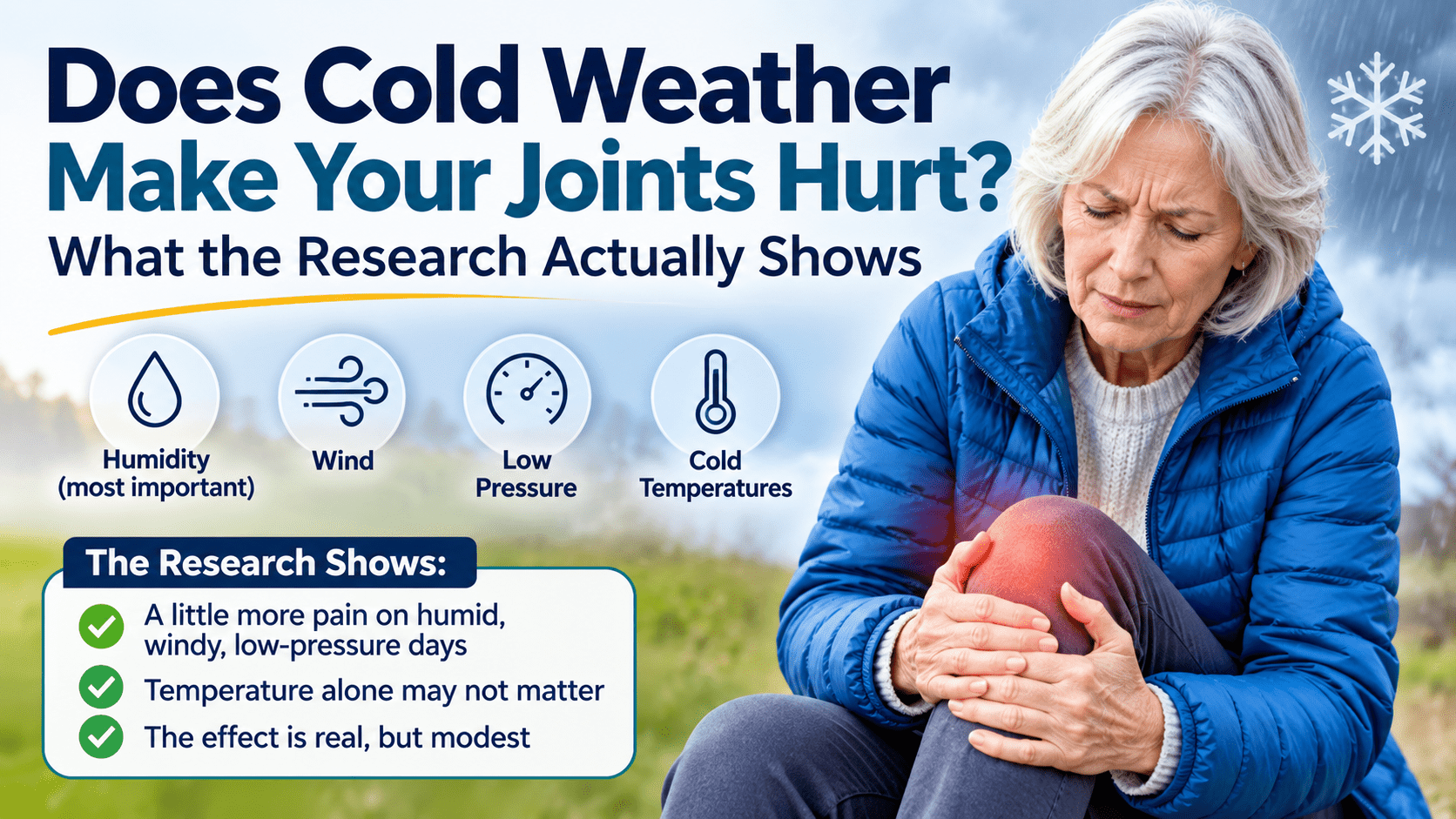
Read Time: 9 Minutes
TL;DR: Probably yes, a little, though not always in the way people expect. The largest smartphone study on the question found pain was more likely on humid, windy, low-pressure days, while temperature alone made little difference. A study of people with knee osteoarthritis found pain tracked colder temperatures and shifts in barometric pressure. Other large studies found no link at all, and psychologists have shown how easily we see patterns that aren’t there. The effect looks real but modest, varies from person to person, and is something you can plan around.
“My knee says it’s going to rain” might be the most widely held health belief there is. Hippocrates wrote about weather and illness around 400 BC, and today surveys consistently find that most people with arthritis believe the weather affects their pain.
For a long time, science struggled to confirm it. Weather is hard to study: it changes slowly, it affects everyone in a region at once, and it travels with other things that also influence pain, from how much we move around to how we sleep. Researchers have come at the question from several angles over the last few decades, and the results are more interesting than a simple yes or no.
The most ambitious attempt to answer the question was a UK project called Cloudy with a Chance of Pain, led by Professor Will Dixon at the University of Manchester and published in npj Digital Medicine in 2019.
More than 13,000 people across the UK downloaded an app and logged their pain daily throughout 2016, while their phone’s location linked each entry to local weather. Most had arthritis. The researchers analysed 2,658 people who reported consistently, each contributing around six months of data.
What they found:
Put together, a damp, windy, low-pressure day was about 20% more likely to be a painful day than an average one. In the researchers’ own example, that’s the difference between a 5-in-100 chance of a painful day and a 6-in-100 chance. Real, but modest.
An earlier study led by Dr. Timothy McAlindon at Tufts-New England Medical Center, published in The American Journal of Medicine in 2007, looked specifically at knee osteoarthritis.
The researchers used repeated pain reports from 200 people with knee osteoarthritis, living across the United States, who were taking part in a three-month clinical trial. They matched each report to daily data from the weather station nearest each participant’s home, and adjusted for factors such as age, weight and use of pain medication.
Two patterns emerged, each independent of the other. Colder temperatures were associated with more pain, and so were changes in barometric pressure. Both effects were statistically significant but small.
Not every study agrees, and the null results are worth knowing about.
In 2017, a team led by Anupam Jena at Harvard Medical School analysed more than 11 million Medicare outpatient visits by over 1.5 million older adults, published in The BMJ. They compared visits for joint or back pain on rainy days with visits on dry days and found no meaningful difference, including among people with rheumatoid arthritis.
That study measured whether people went to the doctor, though, not how much they hurt. Someone with a sore knee on a rainy Tuesday may simply not book an appointment about it. The authors acknowledged that a relationship could still exist and that data on pain severity would be needed to test it.
One of the most cited papers on this topic is a short 1996 study in the Proceedings of the National Academy of Sciences by Donald Redelmeier and Amos Tversky, the psychologist whose work with Daniel Kahneman underpins behavioural economics.
They followed 18 arthritis patients for more than a year and found no statistically significant link between their pain and the weather conditions each patient believed affected them. They also showed 97 students random, unrelated sequences of data, and the students frequently saw connections that weren’t there.
Their point wasn’t that weather-related pain is imaginary. It was that human beings are very good at finding patterns, and a painful day during a storm is memorable in a way that a painful day in sunshine isn’t. That’s worth keeping in mind before reorganising your life around the forecast.
No single mechanism has been proven. These are the leading explanations researchers have proposed:
That last explanation matters because, unlike the weather, it’s something you can change.
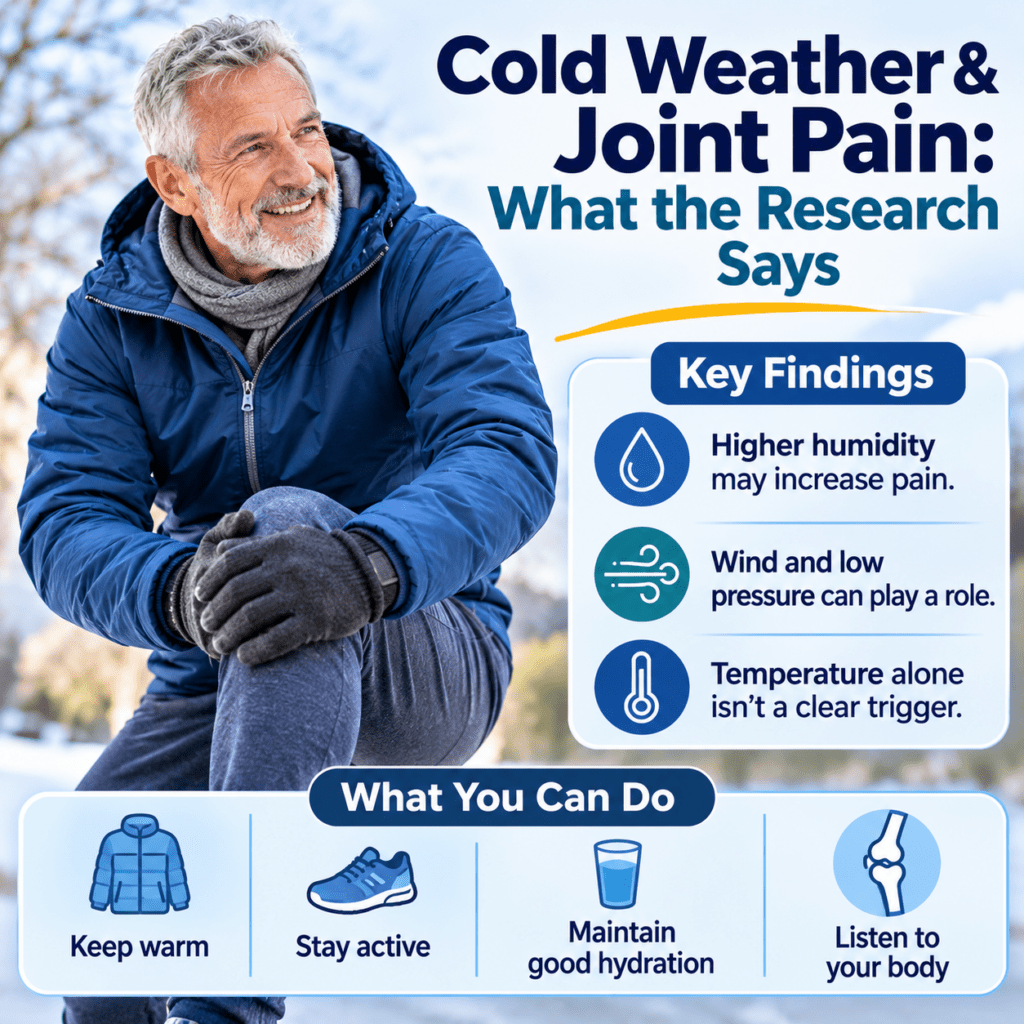
In the research, humidity, wind and low pressure mattered more than cold alone. Staying warm and active helps your joints through the winter months.
Keep moving, indoors if you have to. Regular exercise is one of the best-supported things you can do for joints affected by osteoarthritis, and winter is when routines tend to slip. Walking laps at a shopping centre, swimming in a heated pool, a stationary bike, or a gentle indoor routine all count.
Warm up before you head out. A few minutes of gentle movement indoors gets stiff joints ready before you face cold air or icy steps.
Dress for your joints, not just your core. Layers, gloves, and a knee sleeve or warm leggings under trousers help keep the joints themselves warm.
Use heat. A warm shower in the morning or a heating pad on a stiff joint helps many people loosen up.
Watch the holiday season. Extra weight puts more load on knees and hips, and the stretch from Thanksgiving to New Year is when it tends to arrive.
Keep your supplement routine steady. If you take glucosamine, the colder months aren’t the time to let it lapse. Its benefits build gradually with consistent daily use, which is why consistency matters more than almost anything else about how you take it. We cover that in more detail in our guide on when to take liquid glucosamine.
Track it yourself. The weather studies found that people vary a lot. Jotting down a daily pain score alongside the weather for a couple of months can show whether you’re one of the people most affected, and which conditions bother you, more reliably than memory.
If your joints complain on cold, damp days, you’re not imagining it, though the effect is smaller and more specific than folklore suggests. The best large study points to humidity, low pressure and wind more than cold itself, and the effect varies a great deal from one person to the next.
The good news is that the factors most within your control, staying active, staying warm and keeping your routines steady, are the same ones that help your joints all year round.
It can, but the evidence suggests cold on its own plays a smaller role than many people think. A study of people with knee osteoarthritis found a weak but consistent link between colder temperatures and pain. The largest smartphone study found temperature alone wasn’t associated with pain, but cold days that were also damp and windy could be more painful.
The most likely explanation is the drop in barometric pressure that often comes before a storm, which may allow tissues around a joint to expand very slightly. Large studies have found that rainfall itself isn’t associated with pain, so it’s probably the change in pressure and humidity rather than the rain.
In the Cloudy with a Chance of Pain study of 2,658 people, the combination most associated with pain was high humidity, low pressure and strong wind. Damp, windy, low-pressure days were about 20% more likely to be painful than an average day.
The evidence leans towards yes, with a modest effect. Several studies have found associations between pain and humidity, pressure or temperature, while others, including an analysis of more than 11 million Medicare visits, found no link with rainfall. Researchers have also shown that people readily perceive patterns in random data, so individual experience can overstate the connection.
Stay active, indoors if needed; warm up before going out; keep joints warm with layers, gloves or knee sleeves; and use heat such as a warm shower or heating pad. If you take a joint supplement like glucosamine, keep taking it consistently through the winter, since its benefits build with daily use.
Written by Louie Barone, Chief Technology Officer at Synflex America. Synflex’s liquid glucosamine formulas have been in continuous use since the late 90s, developed and continuously refined by a chemistry team that specializes in liquid supplement formulation and has studied the synergistic combinations of joint nutrients for more than 25 years. I joined Synflex in 2019 and have spent the years since working directly with customers, reviewing the peer-reviewed literature on glucosamine and joint nutrition, and supporting the team behind the formula.
This article is intended for educational purposes and does not constitute medical advice. If you have new, severe or worsening joint pain, see your doctor. These statements have not been evaluated by the Food and Drug Administration. This product is not intended to diagnose, treat, cure, or prevent any disease.